Erik Griffin · 6 October 2026
The Impact of Post-Fire Regrowth on Aquatic Insect Populations in Foothill Streams
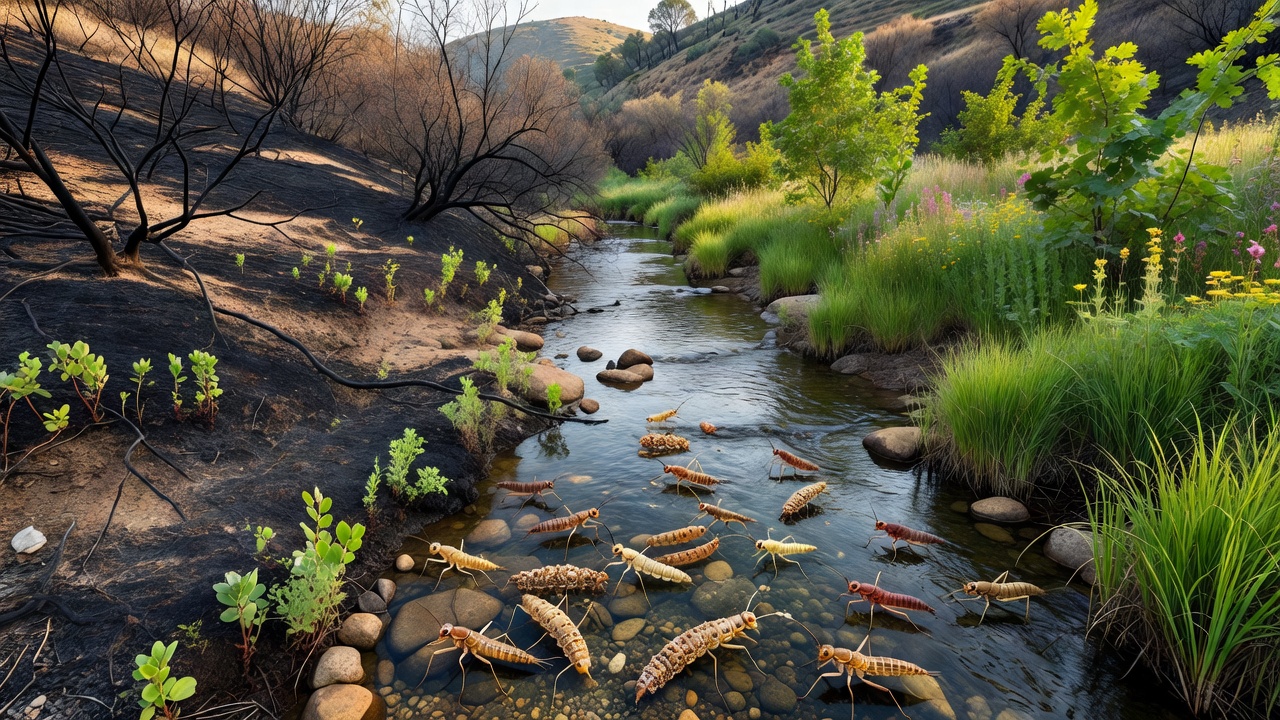
Wildfires reshape foothill streams in ways that extend far beyond the initial burn, and the regrowth phase brings measurable shifts in aquatic insect communities that researchers track through long-term monitoring programs. Sediment loads spike during the first rains after a fire, yet as vegetation returns the nutrient balance tilts toward higher primary production that supports certain insect groups while stressing others.
Early Post-Fire Conditions and Insect Responses
Immediately after a blaze, increased runoff carries ash and fine sediment into channels, which reduces light penetration and alters substrate suitability for many benthic species. Mayfly and stonefly larvae often decline sharply because their gill structures clog easily and because the loss of riparian shade raises water temperatures beyond their tolerance ranges. Caddisflies that build protective cases from sand or organic matter face different pressures as the supply of suitable building materials changes with each storm pulse.
Studies conducted across multiple western North American basins show that total insect biomass can drop 40 to 70 percent in the first two growing seasons following high-severity fires, according to records compiled by the U.S. Geological Survey. Recovery trajectories depend heavily on the rate at which canopy cover returns and on the stability of stream banks once root systems reestablish.
Vegetation Regrowth and Nutrient Dynamics
As shrubs and trees colonize burned slopes, leaf litter and root exudates deliver organic carbon and nitrogen into the water column at rates that exceed pre-fire baselines for several years. This pulse fuels algal growth that in turn supports collector-gatherer insects such as midges and some mayfly genera. Observers note that these taxa often rebound faster than predators or shredders, producing temporary shifts in community composition that persist until the riparian forest matures.
Data collected in similar foothill systems in southeastern Australia indicate that macroinvertebrate diversity rebounds to within 80 percent of reference conditions within five to seven years when regrowth includes a mix of native hardwoods and understory plants. The same datasets reveal that streams with slower canopy closure experience prolonged dominance by tolerant dipteran families.
Seasonal and Hydrologic Influences Through 2026
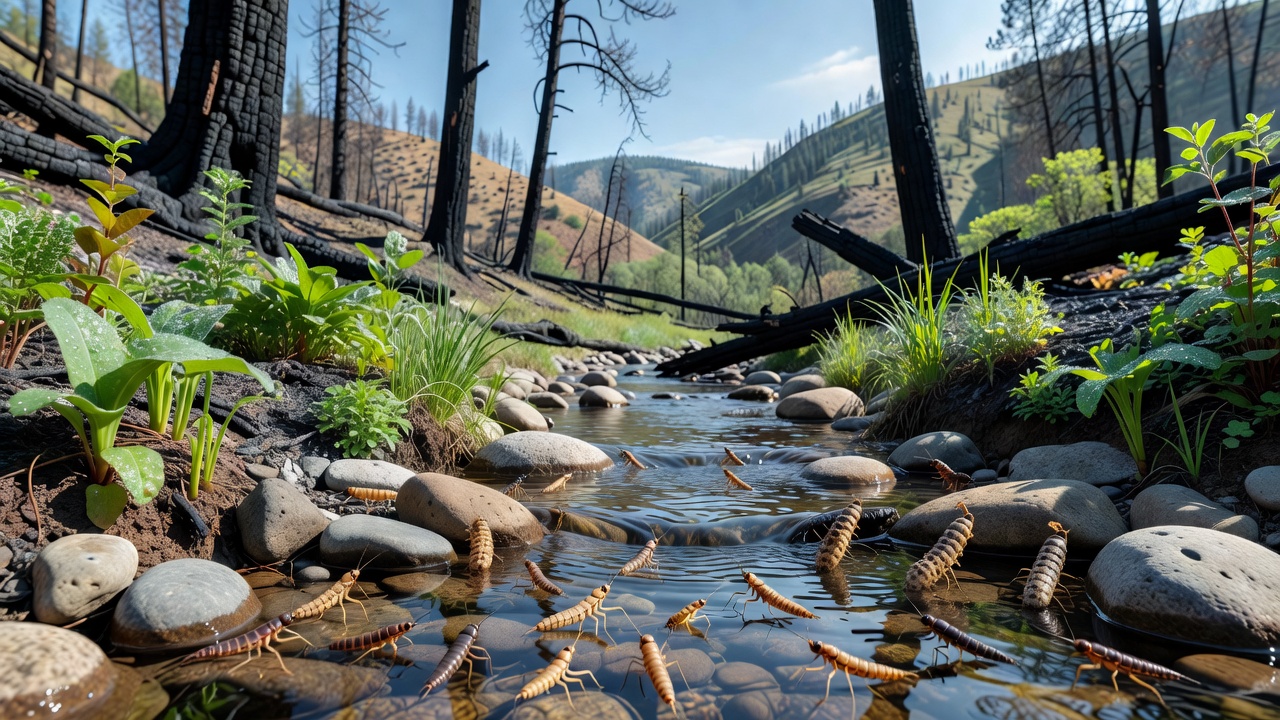
By October 2026, monitoring networks across the Sierra Nevada foothills had documented several seasons of above-average precipitation that accelerated regrowth in many recently burned catchments. Higher winter flows redistributed sediment and created new patches of stable gravel that favored stonefly colonization, while summer base flows remained elevated because increased transpiration from young vegetation had not yet offset the loss of deep-rooted trees. These hydrologic changes produced measurable differences in insect emergence timing, with some caddisfly species appearing two to three weeks earlier than historical averages.
Researchers working in the Canadian Rockies have recorded parallel patterns, noting that regrowth of deciduous shrubs along foothill streams correlates with higher densities of net-spinning caddisflies that exploit the increased suspended organic matter. Temperature moderation from partial canopy recovery further supports these populations by keeping daytime maxima below lethal thresholds for sensitive taxa.
Community Composition Shifts Over Time
Long-term sampling shows that the initial dominance of tolerant midges and blackflies gives way to a more balanced assemblage once leaf litter inputs stabilize. Shredder insects that process coarse detritus increase as deciduous regrowth supplies a steady supply of leaves, while scraper insects respond to the thickening periphyton mats that form under recovering shade. Predator insects such as dragonfly larvae return more slowly because their prey base must first rebuild.
Figures from multi-year surveys in the Pacific Northwest reveal that functional feeding group ratios approach pre-fire conditions between eight and twelve years after moderate-severity burns, although full species richness often requires longer intervals when high-severity patches remain extensive. These timelines shorten in areas where salvage logging or active revegetation accelerates canopy closure.
Conclusion
Post-fire regrowth alters foothill stream ecosystems through successive changes in sediment transport, nutrient loading, temperature regimes, and organic matter supply, each of which exerts distinct pressures on aquatic insect populations. Monitoring data collected through 2026 confirm that recovery follows predictable stages yet varies with burn severity, precipitation patterns, and the composition of returning vegetation. Continued observation across diverse regions will clarify how these processes interact over longer timescales.